Sunday, 17 January 2016

But it takes so long!

The ingredients ready to go - I love this moment
When I tell people that I make my own bread they often seem a little confused. "How do you find the time?" they ask. The truth is I live a very busy life but making bread does not take a lot of time at all. The active time to make the bread I made today was about 30 minutes. The problem comes when you take into account that those thirty minutes were spread over a three hour period.
Today's loaves were seeded bloomers. I simply added 120gms of a mixture of linseeds, pumpkin seeds and sunflower seeds to my standard white bread recipe and let the yeast do the rest!
Dough brought together and kneaded.
Upon tasting I think my next batch will have either some rye or some wholemeal flower in them. Writing new recipes is, after all a work in progress. Anyone who is reading this by accident or because my slightly weird evangelical zeal for food made from scratch, needs to make their own bread. Your house will smell like a dream and your loved ones will never let you buy a cheap plastic wrapped loaf again!
Ready for the oven.
These two loaves came in at about £1.20 each. They would be about 40p less if one removed the seeds from the recipe. (It is worth noting that additional flavours and textures: seeds, nuts, dried fruit, etc. add a great deal to the costs). Get baking people!


Out of the oven and cooling.

Friday, 1 January 2016

Happy New Year!

This post may come as a bit of a surprise to those of you who thought I had stopped writing this blog but I'm back! Further to this I'm also now tweeting so in due course I shall try to link my twitter account to this blog and bring the whole thing together! For the mean time I am MarkBond@cornetcotcook for those of you who also tweet.
Barely a day, week or year goes past without being given some purpose: Word Aids Day, Anti Bullying Week, and now the Pope has declared this year the Year of Mercy. At the risk of upsetting the Holy Father, I would like to suggest (quite respectfully) that we make this year the Year of Cooking From Scratch. It is high time we took back control of what goes into our food and the best way of doing this is to start with raw, base ingredients and make our food from scratch. I am not suggesting some kind of self sufficiency with everyone raising a few pigs and chickens as we need to be realistic. Sourcing our ingredients well must be a priority and then treating them with the respect they deserve.
People work hard to produce and grow food, often with paltry financial rewards, isn't it about time we made the effort to make the most of every single ingredient? Photos of my first bake of '16 to follow.

Sunday, 6 December 2015

Bread demonstration at the Baptist Church.

Yesterday I had the pleasure of demonstating basic bread making to an audience at the Baptist Church in Haddenham. Having made up a focaccia, a plain white loaf, a walnut loaf and a sweet, Christmas spiced loaf the night before I showed various kneading techniques and proving methods. I also made butter live to have with the bread. I shall post the recipes and some photos later. My thanks go to the team at the church.
Yesterday was also the Beautiful Wife's birthday and we have a small tradition that the ladygets exactly what she wznts for her breakfast on her birthday. So yesterday we started the day with Eggs Benadict! I know its basically a heart attack on a plate but what a great way to start the day!

Tuesday, 27 October 2015

Bread recipe - a little late!

Sorry about this I promised a bread recipe a while ago and so here it is! After all making bread is all about patience I suppose.

1KG Strong bread flour
15gms Fresh yeast
15gms Salt
15gms Butter (optional but I like it)
600gms (yes I do mean gms)

In a large mixing bowl, mix the flour, water, broken up butter and crumbled yeast. Work this with your fingers until this all comes together - this will feel really messy but the bowl should come clean by the end.
Then the kneading - Don't flour your surface! Everyone needs to find their own way with this but the idea is to stretch and bring back the dough so that it forms a soft pliable ball. I push the dough away in one stroke then draw it back towards me in juddering rolls. After about 1 minute add the salt and keep on kneading. You should knead for about ten minutes, there is little risk of over-kneading by hand so go long rather than hurrying. Its ok for you and the dough to take a rest in the middle!
Clean the bowl with very hot water and make sure it is perfectly dry. sprinkle a little flour (I mean a little) into the bowl and pop in you dough in a nice ball. Cover with cling film and leave in a draft free place at about room temperature (the warm bowl will give it a head start) till it doubles in size (about an hour). I hate the term "knock back" it sounds too violent. Simply fold the risen dough back on itself and knead quite gently. Pop it back in its bowl with a little four and leave, covered for another hour or so.
Pop the oven on to about 230 degrees. Pop a roasting dish of water in the bottom of the oven.
Lift out the dough and cut in two. Shape these into rugby ball like loaf shapes, place on a baking sheet or baking tray and sprinkle some flour over the top (it won't become part of the bread so be generous) leave gently covered for about 30 minutes.
With a very, very sharp knife or scalpel make three slashes in each loaf. Pop in the oven. After about 10 minutes turn down to 210 and remove the water. Bake until they are as brown as you like! Allow to cool on a rack and enjoy.

Remember - "Real men (and women) bake bread"

Saturday, 22 August 2015

Yeasterday!

No, despite my record the spelling is correct.
Beer kit ready to go
Yesterday I spent an afternoon dealing with the two great uses for yeast.
After my midday swim I began my latest beer kit and also made some bread.
At present I am making beer using kits which can be purchased for between £15 and £24. It is a remarkably simple way to produce 30 to 40 pints of perfectly drinkable beer at a fraction of the cost to buy.
"Pitching" the yeast
Many specialist, micro and craft breweries have grown out of the home brew sector and some, like St Peter's produce kits for people to make their beer at home.
This is the simple, entry level to home brewing and during October I plan to make my first "all grain" brew! I buy my ingredients and kits at Hops and Vines in Witney and the team there have never been anything except encouraging and helpful.
The other part of Yeasterday was the Focaccia which took me several goes to spell correctly (even now I have doubts) This is a great loaf for a lazy lunch with some cheese and dried and cured meats - We're back to trying to work out salami again!
Foca...focca...focac...Italian Bread

Tuesday, 18 August 2015

Bringing home the bacon!

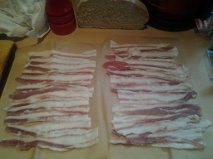
Firstly I must thank Tony, Sally and all the good folks of What's Cooking in Thame who allowed me to use their equipment earlier to slice the pork that has been sitting in my fridge for a week, slowly becoming bacon. Also it was lovely of them to make the right "nyom nyom" noises when we fried off some to taste.
As mentioned earlier in this blog, I made two batches, one standard and one slightly sweeter. To be honest, if you didn't know the sweetcure was, in fact, swetcure then you probably wouldn't have spotted it, but both batches were both edible and clearly bacon.
During a discussion about what I should try next, the single word "SALAMI!" rang out from an office; I am at present trying to work out a way to fully dry and mature a salami, without a cold room, in the UK, without killing anyone who eats it!
I was recently involved in a typically "blokey" debate and I would be interested in anyone's opinion on this: What is the most important component of a Full English Breakfast? Some fell on the side of Bacon others on the side of the Sausage, Egg was considered. One person even suggested Baked Beans (we don't talk to him anymore).

Friday, 14 August 2015

Sausages and more.

It was once said that the two things you should never see being made were Sausages and Laws. I'm sure that this dates back to the days when anything that it was impossible for a butcher to sell went into the sausage meat. Though, with the present cynicism about politics I'm equally sure that the second half of the joke rings true today. I am reliably told , by Jim MacKeller of Orchard View Farm that, as a nation we are eating fewer sausages but we are demanding higher quality sausages too. This is indeed heartening news as quality over quantity is without doubt the way forward if we are to make farming in the UK, and the rest of the world sustainable.
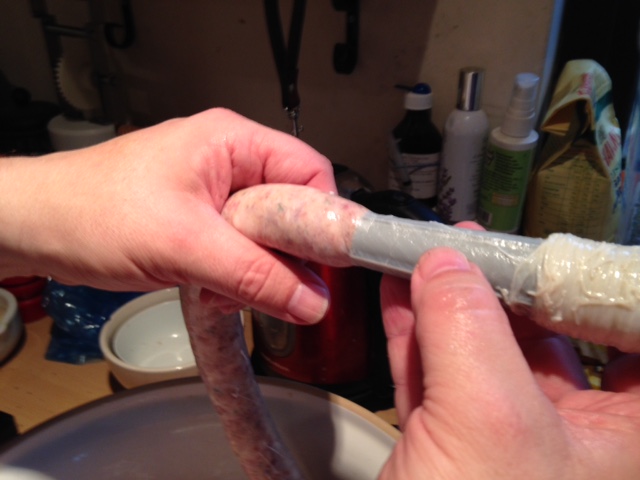
Feeding the meat into the casings.
I did a course on Sausage making at Orchard View earlier this year and, with the time made available by a Teacher's Summer Holidays, I decided to make some at home.
I purchased 3 Kg of Pork shoulder (From Orchard View) and minced this. I split this into three equal batches. I had also bought some natural casings and some rusk.
Keeping everything, including the equipment, as cold as I could, I set about making three very different styles of sausage.
First up was a Toulouse inspired sausage. Much garlic (and I mean MUCH) was crushed and mixed into the meat with some cooked smoked pork loin which was finely cubed. This was seasoned, water and rusk added, and then sent through the gadget!
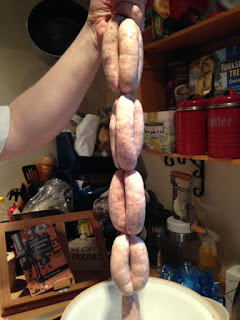
Linked in threes (like knitting with meat!)
Next was an Italian inspired sausage with a little garlic, crushed fennel seeds and some chopped rosemary.
Finally I went to an almost Lincolnshire with sage from the garden of Corner Cottage. I had meant to add some nutmeg or mace but simply forgot!
All three types were cooked and tasted. The Beautiful Wife declared them a success, especially the Toulouse. (Then again, we are both "garlic heads").


I also picked up some Pork Belly and used a commercially available cure (Laycock's) to turn this into bacon. This is being turned and drained daily at the moment so should be ready by the middle of next week. One piece has been simply cured and another has had a little bit of sugar added to the cure.