Showing posts with label Preserving. Show all posts

Monday, 22 April 2019

A Year in Preserving - Saucisson Sec

I have mentioned many times on this blog that I have a great love for all things porcine. My love is never more true than when dealing with the craft and art of the sausage. When trying out a new butcher I always try their basic traditional sausage first, if this is up to scratch then the rest of their meat is likely to be good too. This simple system has stood me in good stead for many years.
I have also expressed my love of books in the past and in my quest to preserve more meats, the Beautiful Wife bought me and American book called simply Charcuterie. This book is written by Michael Ruhlman and Brian Polcyn and mine is signed by Mr Ruhlman. It has a forward by the great Thomas Keller (if its good enough for him....). I have dipped into this book often and last month decided to take the plunge and make one of the recipes. I choose the Saucisson Sec recipe as I have some experience of making sausages and it is one of my favourite preserved meats. The results were very pleasing indeed and we have slowly worked our way through the batch I made. Interestingly when I started to see if anyone one else online had used this recipe, I found Charcuterie all over the place, from blogs to twitter posts, this book appears to be everyone in the States' "go to" preserved meat bible.
Saucisson Sec is one of the memories I brought back from France as a teenager, as I was too scared to bring back the product itself. The chewy, garlicy, pokiness is one of the great treats of the sausage world and that tastes was one of the ways I new I was on holiday.
As ever, I bought my pork from Orchard View Farm in Buckinghamshire (www.orchardviewfarm.co.uk) and my Prague powder #2 from The Coldsmoking Cookery School, just north of Milton Keynes (coldsmoking.co.uk). The recipe below is based on the version in Charcuterie and I cannot recommend this book highly enough.

Saucisson Sec
5lbs Pork (about 15% Fat)
50 gms Sea salt
1 tblsp Ground black pepper
15 gms sugar
7 gms #2 Prague powder
25 gms minced
1 hog cassing

The pork was ground through a 5 mm plate in a hand mixer (going up to 8 mm wouldn't be a problem). This was mixed with all the other ingredients (except the casing) until it was all fully amalgamated.
The mix, nicely amalgamated.
This mix was then stuffed into the casings and made into 15 cm links.
Linked up and ready to dry.

The links were stabbed all over with a sterile pin in order that any air might escape and the product might mature evenly. (Please do not do this if you are making traditional English Bangers or you will be left with a sad, dry digit for your breakfast as all the fat will have drained away).
Drying in my "cellar"
The sausages were then weighed and hung in my cellar (a re-purposed 6 bottle wine cooler)at 15 degrees c for three weeks.
When they had lost 30% of their weight they were tried for quality. They should be stable at room temperature now but I've kept them at 15 degrees with no apparent lowering of quality.
Skinned and ready to eat
The only problem which occurred was a slight stickiness of the skins. This may well have been caused by being a little too clean and my cellar not allowing the "good", white, powdery bacteria to grow on the outside of the sausage. No bacteria grew there!
There are any number of uses for this; from a simple snack to a tasty addition to any kind of braise or rice dish (thin Paella or Risotto, though neither of these are French). Myself and the Beautiful Wife tend to sit down with a glass of beer (sometimes English, sometimes Belgium, sometimes American), some Cheese (often a proper Cheddar, perhaps a piece of Brie, migrating across the board) and some of last year's Pickled Onions (So English that its almost too much!). Bon Appetit! and Happy St George's day tomorrow!

Monday, 18 March 2019

A Year in Preserving - Confit of Duck

Confit of duck is probably the most stereotypical French brasserie dish. It is difficult to imagine settling down to lunch in an establishment, in Paris, on a corner, with tables outside and waiters in waistcoats and not seeing it on the menu. This has led to the assumption that it is a very complex and "chefy" dish requiring skills learnt over many years and a massive batterie de cuisine. This could not be further from the truth, it is a simple dish with it origins in the frugality of rural France.
Fat is the  key. Glorious, rich, delicious fat. The people of Gascony in France enjoy some of the lowest levels of heart disease in Europe yet their diet is very high in both goose and duck, two very fatty meats. We in the UK tend to only get excited about the fat of these two birds at Christmas when we are looking for the perfect roast potato. However, in France they have been using duck fat to preserve the duck flesh for centuries. Again the necessity of preservation has led to the invention of gastronomic genius. This dish comes from an era when the closest thing to a fridge was a larder, probably a North facing room with slate shelves to keep food as cool as possible.
A great deal of meats can be confit but by far the most common is the duck leg and this preservation is a really simple two part process: Salting to cure followed by cooking and sealing in fat. The recipe below is for the simplest form of confit, adding spices to the cure is perfectly acceptable but I tend to keep the dish as pure as possible.

2,4 or 6 Duck legs
Salt
Duck fat (I have used pork lard with no drop in quality)

Place the duck legs in a large bowl and sprinkle over salt, just enough to give a light covering. Pop them in the fridge for about six hours. They will loose a bit of water and firm up a bit.
Take the legs out of the fridge and wash off the salt making sure that you then dry the legs thoroughly.
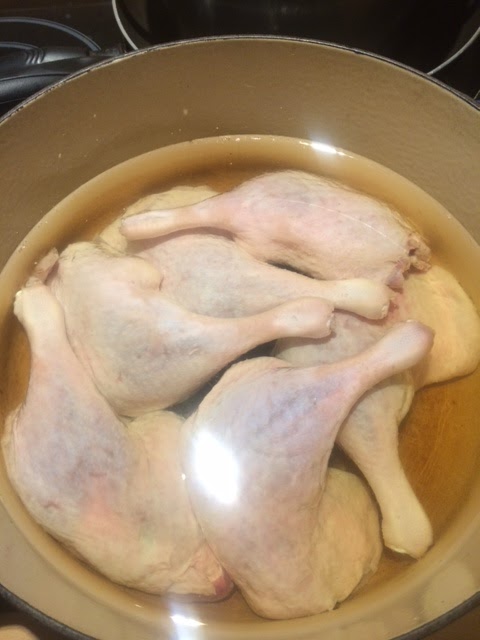
Melt the fat in a large casserole and carefully place the legs into this fat until the are all in the fat and covered.
Duck legs in the melted fat
Pop the lid on the casserole and put it in the oven at about 150 degrees centigrade. Leave them alone in the oven for a little over an hour, when you take the lid off there should be a lovely and light brown and smelling wonderful. 
Take the duck out of the oven and allow it to cool in the "larder" until set, its worth checking that all the duck is under the surface of the liquid before it sets. With the duck cured and cooked and also all the air now excluded, this food has a considerable shelf life.
When you want to finish the duck, you simply pull it out of the fat, wipe as much as you can of the skin and put it in a hot oven on a tray for about 15 minutes to crisp up the skin.
Out of the fat and ready for finishing.
 
The only question you have left is what to serve with your confit. For me, the summer calls for a simple frisee salad with some lardons of un-smoked bacon all dressed with a sharp vinaigrette . In the winter a pile of puy lentils mixed with sliced onions and lardons (again).


Wednesday, 15 August 2018

Day one!

Really busy day of vegetable cutting. It began with the preparation of the vegetables for the Picalilli. This pickle is a throwback to the Raj and in that way has a particularly interesting set of ingredients and flavours. I reckon that five or six different vegetables are required to give the level of interest required. This morning I chopped 400gms of runner beans (from a neighbour whilst they are on holiday) 400gms of courgettes, turning to marrows (another gift from a neighbor) 400gms of cauliflower, 400gms of onions, 200gms of butternut squash (found in a car park!) and 200gms of tomatoes from the massive box I purchased in Thame market yesterday for just £4. I then set about cutting everything up and mixing them. To this I added salt and it is, at present, sitting in a cold corner to lose a little liquid and keep everything crisp.

Raw Picalilli

Next I started work on a Tomato and Courgette chutney. With all these preserves there are a plethora of recipes on line. I have taken a 'pick and mix' approach to this recipe. I chopped 400gms of courhete and the same amount of tomatoes. I also chopped 6 small onions and 5 small apples.

To this I added 150gms of raisons and 150gms of dried currants. I disolved 400gms of dark soft sugar Iin 500ml of white wine vinegar. To this I added a stick of cinnamon stick and a finely chopped finger of root ginger. I also threw in a tablespoon of mixed spice. When all was disolved I added the vegetables and brought the whole lot to the boil. This was then simmered for nearly three hours. It wasthen bottled Iin the normal way.
Raw Chtney

Chutney at the start of the cooking process