Wednesday, 30 August 2017

The generosity of preservation.

It started, as many good things do, with apples. In truth, it started with a phone call about apples. A colleague from school, who lives near called and invited me over to take as many apples as I liked from the tree in her garden. The tree was laden with large ripe fruit, easy to pick and heavy in the hand. I returned with two large carrier bags full and all sorts of ideas about what I would produce.
I have said before that I love this time of year, the huge quantity of food treats available during late summer and early autumn mean that I spend a great deal of my time trying to decide what to cook next. This summer has been quite strange with fruits ripening at strange times and certain treats being harvested at the same time. This is a time of abundance and at such times most people are prepared to share their bounty. This is the first of my blogs about preserving this year and so far I have made nine different preserves (if you count Damson Gin) and to date the major ingredients of each preserve have not been purchased. They have been grown in the tiny plot at Corner Cottage, donated by friends or picked in the hedgerows around this lovely little village.
There is a sense that making jams, chutneys and ketchups is the preserve (sorry) of middle class ladies who live in the country or at the very least leafy suburbia. This may be true but it should be nonsense. My very first experience of making jam was when The Beautiful Wife and I lived in Wembley. I picked blackberries from a piece of common waste ground behind Neasden Sidings and made a glorious jam. As for the economics, you could probably buy a cheaper jam at the bottom end of the grocery market but that is not a fair comparison. The fairer comparison would be with high quality, high fruit content jam at about £2 a pot. My Spiced Apple Jelly costs about 60p a pot.
In terms of waste reduction there are clear reasons to use up all the surplus of this season in order to have treats in less abundant times. This sounds very old fashioned but why on earth would you buy chutney in March if you made a batch from left over vegetables in September and still have a cupboard full of such treats.
Having a stash preserves also gives you the opportunity to be generous. I consider it very bad form not to provide the fruit donor with a couple of pots, but also, most people who visit us here will be walking away with a pot of jam or c
hutney this coming year.

Spiced Apple Jelly

Couple of lemons
Apples (Cookers are best) However many you get!
Sugar the amount will be dictated by the amount of "jelly juice" that is caught
Spices (Stick of Cinnamon, 5 or 6 cloves, couple of slices of ginger)
Mug or two of water.
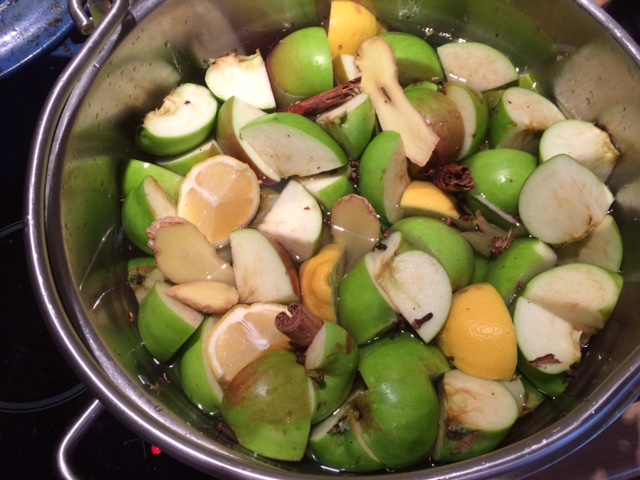

Raw materials at the start

First pop the water in a preserving pan or stockpot, then quarter the lemons and add them to the water. Chunk up the apples and add them to the lemon water add the spices and boil. Boil until everything is very soft and mushy. This is where the clever stuff happens. Put all of the pulp in a jelly bag or piece of muslin held up by any sort of frame, suspended over a bowl. (The first time I did this the muslin was suspended between the taps and handrails of my bath with a mixing bowl to catch the "jelly juice"). You can leave this for quite a while, even overnight, three hours normally does it. The juice you have caught (I call it Jelly Juice) should feel a bit slippery to touch.
Measure the volume of the liquid in pints. Add the liquid to the (now cleaned) preserving pan and add sugar to the juice with a ratio of 1 pint to 1lb (old fashioned, I know). Help the sugar to dissolve by stirring over a moderate heat and then boil until setting point is reached (105 degrees c. but you get a feel for it pretty quickly)


Boiling up to setting point

 Pot the jelly carefully, avoiding the scum* and pop the lids on. Label and enjoy.
* I keep the scum in a jar to stir into gravy as no-one will ever know. 

Potting up the jelly


Sunday, 9 July 2017

New salad. Inspiration or happen-chance?

Sometimes things just come together. The right things are in the right place at the right time. This happens in food quite often we just have to capture the moment and revel in it.
As I was about to leave the Haddenham Beer Festival last Saturday I walked past a stall selling olives and such where I saw some lovely looking feta cheese and, with no specific purpose for it, I bought a piece anyway. The Beautiful Wife and I had attended the Festival with The Rocket Scientist and his wife Dr.L. They were due to spend the following day with us learning how to make bread.
When I got home my first three courgettes had grown to a perfect size. One of my favourite things to do with courgettes is to slice them very thinly and, having rubbed a little oil on them, I pop them on a griddle pan until they have light brown lines on them and they are soft and yielding - a little salt here is essential.
Having done this, I was taken by a strange burst of inspiration and added mint from my garden also. Then the feta was cubed and added and a light drizzle of lemon juice. This all came together in such a short space of time that it felt a bit shocking when it tasted quite sublime. I would love to claim that this was born out of my culinary genius but it really was just a few things coming together.

Ingredients
2 or 3 courgettes
One block of feta cheese
A handful of mint
Lemon Juice
Salt
Olive oil

Slice the courgettes thinly using a vegetable peeler and put the in a bowl with a little oil. Rub the courgettes until each slice is very lightly coated. Heat a griddle pan with ridges until it is quite hot and fry the slices, turning so each side is softened and a little charred. This will take a while as there will be 3 or 4 batches. Put the cooked courgette slices back in the bowl and add a crunch of sea salt.
Cut the feta into small cubes and add to the courgettes. Also add a hand full of mint leaves (torn not cut). Finally add a good squeeze of lemon juice and stir very gently. Serve as a side salad or a main course.

Tuesday, 23 May 2017

Always learning.

As I have mentioned in previous posts, a few years ago I decided that I was going to stop trying to create Michelin stared dishes in the kitchen at Corner Cottage and find out much more about the basics of food production. This change of heart was caused by both a genuine interest in the basics of food supply and by the fact that I was clearly never cut out to produce food that was that pretty or required that many processes. Since then I have learnt how to make bread, how to make butter, how to make sausages, how to make bacon, how to make beer and, a few weeks ago, how to make cheese.

I attended a course at High Weald Dairy on the edge of Ashdown forest, a very highly rated organic dairy run by real enthusiasts. The quality of the course was fantastic with Mark, Sarah and Chris ensuring we had all the information, assistance and encouragement we needed. I came home with a selection of flavoured cream cheeses for immediate eating and a kilo of hard cheese to mature at home. I also bought one or two of their cheeses too and they really are quite superb. We were talked through a range of their products after an excellent lunch. I can only highly recommend this course. I am now saving up for some more kit to begin making my own!

Along with the cheese I brought home a few litres of the whey left over from our efforts. It is a waste product and is also quite environmentally dangerous if it is not disposed of carefully (by feeding it to pigs, for example) On advice I used this instead of water in my normal white loaf mix and it produced excellent bread. It had a hint of sourness about it without being a sour dough!
Bread made with whey
In other news, as some of you may know I am finally practicing what I have preached for so long. I am now teaching cooking to a large cross section of the young people at thew school where I work. This makes for many interesting moments and juxtapositions of ideas. How many people, in there normal working day, go from explaining the Public sector Borrowing Requirement to trying to convince an 11 yr old that a courgette is not an aubergine!

Monday, 30 January 2017

Something to write about!

When I began to write this blog many years ago I decided that I would only write when I had something of value to write about. I also wanted my blog to be largely positive and for it to be about finding food solutions not food problems. I have only written once since March and the reason for this is not just that I had nothing to say but also the fact that I have been very busy at the chalk face and taken on some new responsibilities. In short, I am now teaching food to a group of Yr 10 and a groups of Yr 11 students thus fulfilling a long held wish to help young people develop their skills in a kitchen.
As we left 2016 behind, many of us breathed a heavy sigh of relief that a year in which societies and communities seemed to be moving further apart and splitting was over. We have seen countries torn apart in civil war, referendums make people feel their nieghbour despises them and elections bring out the worst in people This is how community cohesion falls apart even in areas which are not directly affected. This is all very sad indeed.
In their book "Jerusalem". Yotam Ottolenghi and Sami Tamimi talk of how hummus is a universal food throughout this most fractious of cities. Hummus as a healing agent is a bit of a bizarre concept but the idea that food itself can heal rifts that politicians and diplomats cannot merits investigation. after all eating is one of the things that all humans must do. As Ottolenghi and Tamimi put it "Food is a basic, hedonistic pleasure, a sensual instinct we all share and revel in, it is a shame to spoil it."
There are lots of reasons why we don't all eat the same things, religion, wealth, location and culture all play their part in deciding what we have for dinner but there is always common ground. In my experience most people who restrict their diet for conscience, religion or health are rarely unpleasant to those of us who consider themselves omnivores. Many is the meal I have had with Jewish or Muslim friends where items which were not Kosher or Halal were simply avoided. Once even playing cricket against a side made up of Muslims during Ramadan we decided to take our tea swiftly in order not to make the other team feel at all awkward at the break between innings. A small adjustment for us which was recognised by the opposition and opened a conversation about how difficult Ramadan was in the height of summer and how great it was to break their fast when the sun went down!
When we eat together we break bread. Bread is central in one form or another, to nearly every culture on earth. Our friends are sometimes called our companions (with bread). It is a fanciful thought, but wouldn't a great deal of strife be avoided if we saw our neighbour, be they local, national or global, as somebody with whom to sit down a break bread? It is very hard not to empathise with a human when you are sharing their food, especially if it tastes great.
During the next 100 years availability of food and water may well be the cause of growing inequality, anger, and even war. Unless we are prepared sit down, break bread, talk, laugh, and listen, really listen to each other, then how can any of us claim to be truly civilised?

Thursday, 26 January 2017

When no meat is needed.

Today I did a demonstration of a Dhal for my Year 10 (young people rising 15 years old) group today and it went down quite well with them. However, it went down much better in the Staff Room after School was finished.
This recipe is a simplification of the superb Coconut and Spinach Dhal from the guys at What's Cooking in Thame. In order to make it easier for myself I have replaced hard and fast ingredients with choices. I seldom have all the ingredients I want at the right moment in the little kitchen of Corner Cottage! The recipe may seem a little free and open to interpretation and for this, I make no apologies.

Ingredients
Spices whole - 1 tsp Mustard seeds, 1 tsp Cumin seeds, any others you fancy (Fennel might be nice nor maybe Clovers)
Spices ground - 1 tsp Turmeric, 1 tsp Chilli powder (hot as you like!), any others you fancy (maybe Coriander, or even a blend like Baharat)
Fresh Chilli - probably 1 medium
Garlic - a couple of cloves
Ginger - about an ich
1 onion
250 gms Split Red Lentils 
1 tin Coconut Milk
1 tin Plum Tomatoes
200 gms Baby Spinach (you could use Rocket, or even sliced Kale)
Oil (You could use Butter, but with oil it's vegan!)

Fry the whole spices in plenty of oil until the mustard seeds start to pop. Add the onions, chilli, garlic and ginger and fry for a 3 or 4 minutes. Add the ground spices and stir in cooking them for just two minutes. Add the lentils stirring so that they get a coating of the whole spicy mix then pour in the tins of tomatoes and coconut milk. Keep this on a high heat until it boils then add the spinach and wilt down into the dhal. It is important that you do not add salt until the lentils are cooked - none of the pulses really like it, it makes the tough and grainy. Hold the dahl at a gentle boil adding water if necessary. When the lentils are soft and smooth (after about 20 minutes) you might want to add some chopped coriander leaf or mint, you could also add a squeeze of citrus here. Season and serve. A pot of yoghurt on the side will help if you've gone a bit crazy with the heat.

It is really a very long time since I wrote, but I promise there will be more posts this year!


Monday, 14 March 2016

The joys of getting back to the start.

I do not, nor have I ever owned a dishwasher. The kitchen at Corner Cottage, much like the rest of this lovely home, is small. There is no space for a dishwasher. As somebody who worked as a chef before he really cooked at home I was a bit of a late starter when it came to washing up. For many years it was a task to be avoided until either I or my flatmate finally cracked and went into a 3 hour frenzy to get the kitchen back into shape.
The tiny kitchen in our cottage and the clear standards set by the Beautiful Wife have meant that I have left those lazy days behind. As the kitchen is my domain, I too take the majority of the responsibility for the washing up and slowly, very slowly it is a process that I have grown to love.
Nigel Slater writes in his wonderful book Appetite about the "contented murmur of a full dishwasher from somewhere behind you in the kitchen" at the end of a night. This is not an experience I expect to have. He also talks of how washing up by hand "could be faintly relaxing, especially if you have got the water to the perfect temperature and were taking your time over it".
My experience of washing up is one of getting back to the start point. There is something slightly heroic about entering your kitchen for the first time in the day and seeing everything in its place, everything clean and eager for action, everything just ready. Knowing that my kitchen is ready for its (and my) next adventure is a source of both deep satisfaction and excitement to me. Once I know my cooking space is ready for tomorrow I can sit down and plan. I always feel that, if the kitchen is not ready, then I am not allowed to think about the next meal.
Towards the end of the Great Gatsby, when the whole glorious world has come to an end, the narrator talks of someone turning up at Gatsby's house who was "probably some final guest who had been away at the ends of the earth and didn't know that the party was over." Washing up waiting to happen, seems to me like the people who don't know when its time to go home, they need to be washed and placed back where they belong and then I can relax, with the Beautiful wife and maybe a cat or two.

Monday, 8 February 2016

Why we should love our "Ugly Duckling" food.

There is an dangerous obsession among food consumers in the UK: Conformity.
As a nation we have a view of how a certain ingredient should look and, backed up by the supermarkets, we stick to it. A carrot should be a specific length, specific girth and a very particular hue of orange. An apple should be the "perfect" shape and exactly the right mix of green and rosy red. All loaves of bread should look the same.
This is, of course a complete nonsense, however this myth of food perfection and adhering to very specific norms pervades our supply chains and hence, our cooking. This is not helped by the fact that we have hundreds of highly skilled chefs in the UK who produce dishes which seem awesome in their levels of accuracy and conformity.
Ugly bagels just before the oven
Not quite swans but quite delicious
I have absolutely no problem with great chefs doing this but we are foolish, as home cooks, if we follow the same slavish adherence to "the perfect". When we are feeding those we love, it really is all about the imperfections, much like falling in love itself. The fact that food has, on it, marks made by the hand of the cook is a thing to be celebrated in our homes. The only thing worse than this "perfect" food in our home kitchens is food which has been made to look "rustic" or "paysan". We really are just making something for supper, stop trying so hard!