Friday, 17 August 2018

Day two!

I am writing this a day late as time got away from me yesterday. So the next preserve was Picalilli. Having done all the cutting on the first day of preserving, the vegetables were salted and left for 24 hours. The mixed veg was then rinsed of the salt and patter dry with kitchen paper. I then blended 60gms of cornflour with 20gms of turmeric, 10gms of ground coriander, 2tsp of mustard seeds and 2tsp of whole cumin seeds. This dry mix I turned into a paste with a splash of pickling vinegar.
I then warmed about 1.2 litres of picking vinegar with 300gms of sugar. When all the sugar was dissolved a little more of this liquid was added to the yellow paste and then all the paste was added to the vinegar. All the veg was mixed into this and folded in to coat everything.
Two last additions of a very finely chopped red chilli and 100gms of honey and the Picalilli was popped into sterilised jars. Ready for labelling.
Getting the last jar out

Jars ready for the cupboard - cold cuts at Christmas


Wednesday, 15 August 2018

Day one!

Really busy day of vegetable cutting. It began with the preparation of the vegetables for the Picalilli. This pickle is a throwback to the Raj and in that way has a particularly interesting set of ingredients and flavours. I reckon that five or six different vegetables are required to give the level of interest required. This morning I chopped 400gms of runner beans (from a neighbour whilst they are on holiday) 400gms of courgettes, turning to marrows (another gift from a neighbor) 400gms of cauliflower, 400gms of onions, 200gms of butternut squash (found in a car park!) and 200gms of tomatoes from the massive box I purchased in Thame market yesterday for just £4. I then set about cutting everything up and mixing them. To this I added salt and it is, at present, sitting in a cold corner to lose a little liquid and keep everything crisp.

Raw Picalilli

Next I started work on a Tomato and Courgette chutney. With all these preserves there are a plethora of recipes on line. I have taken a 'pick and mix' approach to this recipe. I chopped 400gms of courhete and the same amount of tomatoes. I also chopped 6 small onions and 5 small apples.

To this I added 150gms of raisons and 150gms of dried currants. I disolved 400gms of dark soft sugar Iin 500ml of white wine vinegar. To this I added a stick of cinnamon stick and a finely chopped finger of root ginger. I also threw in a tablespoon of mixed spice. When all was disolved I added the vegetables and brought the whole lot to the boil. This was then simmered for nearly three hours. It wasthen bottled Iin the normal way.
Raw Chtney

Chutney at the start of the cooking process


Tuesday, 14 August 2018

And so I'm back......

When I started to write this blog I gave myself a few rules. I was going to make every effort to be positive, there was to be a thick vein of ethics throughout the food I blogged about, and I was only going to write when I felt that I had something to say.
This academic year was a bit manic and so, finding the time to blog has been tricky and I have a 'wodge' of sheets of paper with ideas, concepts, mind maps about food and foodie issues. I am aware that I have said this before but I really must find time to write. The things I have yet to write about include food education, rhubarb gin, preservation methods, smoking ones own salmon and preserving for gluts. So I am not short of inspiration!
As I type a large part of Corner Cottage is full of vegetables mainly given to me by other residents of the village. There are courgettes that have turned to marrows, cauliflowers, and runner beans so there is to be a two day frenzy of chutney and piccalilli!
I'll post more tomorrow! (I promise).
This will be a kind of trial run. In the new year I plan to tell the story of a year in preserving writing two blogs a month seasonally examining how we can preserve good things when they are plentiful.

Sunday, 28 January 2018

Marmalade for the year


When Mary Queen of Scots, whilst crossing the Channel and North Sea to claim the throne, fell ill, her lady in waiting, a very practical woman by all accounts, boiled up a soup of bitter oranges and sugar to help the young Queen recover. When asked why she had done it she replied by saying, "parce que Marie est malade." So a name for a new product was born - Marmalade! This is, of curse complete twaddle and not the truth at all. However it is a great tale and should be told to all children in order that they see the effect of history on our food culture and also see the importance of learning a foreign language.
The real etymology of the word comes from the Portuguese word for quince "Marmelo"  which was made into a paste "Marmelada". This was often imported to England along with Port, Madeira and other wines. It was sometimes flavoured with other things such as citrus peel and the Marmalde as we know it was born, or rather, developed.
This weekend I made a 3 kilo batch of my basic recipe marmalade. There is a very small window of time in the calendar to make this staple of the breakfast table. Seville oranges are only available for the first 6 weeks of the year so enough should be made for both the whole year and presents as well.
Making one's own jams and preserves often works out to be more expensive than buying the major brands in the super market. However, one's own product is nearly always much better than that purchasable in the shops. If one can get hold of fruit for free then both the cost and quality are to the advantage of the maker.
In the film, Gosford Park, Dame Maggie Smith's character, Constance, the Countess of Trentham, is appalled by the fact that she is served "shop bought" marmalade on her breakfast tray. For once I am on the side of Nobility in this.
I think that one of reasons for home made marmalade being so much more appealing than shop bought lies in the level of sweetness. A wiser man than I once told me that marmalade should feel like a cold shower to the taste buds first thing in the morning. A ratio of 1:2 (Fruit to sugar) should be the absolute maximum for a real marmalade.
Below is my basic recipe for marmalede it has never failed me. In order to make the recipe yours simply change the type of sugar, maybe add whisky or brandy - the world is your orange (Seville, of course)

Seville Orange marmalade.

1 Kg of Seville Oranges (unwaxed of course)
1 lemon (unwaxed of course)
2.5 Ltr water
2 Kg of granulated sugar

Place a sieve over a preserving pan and, having cut all the fruit in half, squeeze all the juice trough the sieve into the pan. Make sure you keep all the pips. Scrape all the inner pith out of the skins of the fruit and add it with the pips to a square of muslin and tie it all up. Slice up the outer skins as thin as you like and add them to the juice.
About a third of the cutting done

Now add the water and the muslin bag to the pan and boil for 1 and a half hours.
First boil
Remove the muslin bag from the boil and, when it has cooled squeeze it gently into the boil. There will be a lot of pectin here but don't wring it out as it will create cloudiness in the marmalade. 
Now add the sugar and boil the liquid until setting point has been reached (this can be tested using the wrinkle test, where a drop of the liquid is placed on a very cold plate, if it wrinkles when pushed with a finger, then nit is ready.
Ready for their labels
Pot in sterilised jars and  label.


Friday, 29 December 2017

Smoking!

During November I spent a day at Cold Smoking (Coldsmoking.co.uk) on a food smoking course. Turan, who ran the course was quite simply excellent and his easy engaging style meant that all of us on the course went away feeling not only capable of producing our own smoked food but also enthused and excited about giving it a go. The course was a gift from the Beautiful Wife and as such I was able to save some spending money which I spent on equipment to begin smoking, a kind of cold smoking beginners kit, if you will.
With the last few weeks of Autumn term being so hectic it was only on the 22nd December that I was in a position to begin. A side of Salmon was salted for 6 hours and the dried in the fridge for a further 24. The fish firmed up a bit and developed a feel like sticky latex rubber. I then fired up the smoker and let the wonders of salt, smoke, fish and time do their stuff. I have to confess at this point that I was not expecting any great results from my first try at home; I was working on the basis that anything edible would be a bonus.
After 5 hours I removed the fish and packed all my kit away. Unable to resist, the Beautiful Wife and I carved ourselves the thinnest of slices. It was quite delicious!
A day later and the salmon was even better. Owing to the fact that the fish was salted and not brined there is less of a sense of wetness in the fish and more a feel of fish oil. Probably the best smoked salmon I have ever tasted.
So far a piece has been used for a gift, we used some in our Eggs Royale on Christmas morning and I am looking forward to serving it with scrambled eggs to my mother tomorrow morning!
I cannot recommend the course highly enough, if you think that a home produced luxury product can't match the top commercial brands you are very much mistaken in this case.

Sunday, 3 September 2017

More preservation

On the same day as I was collecting apples (see previous post), the beautiful wife was being visited by a friend who also happens to be a very talented artist (we have two of he paintings). The Artist has a damson tree in her garden so she arrived with two and a half kilos of damsons. I am a huge fan of this humble type of plum. They are not really edible straight from the tree but they have such depth of flavour once they meet heat, alcohol or sugar (or, indeed any combination of the three).
This is where free food is at its best. It is not necessary to have friends with lucky gardens. Damsons grown in our hedgerows they are often planted as part of a hedge for their ability to provide very good shelter from wind. They can be harvested, along with their friends the bullaces for a small investment of time. Also, in a good year, almost everyone who has a damson tree will be only to glad to give them away as they can be fantastically prolific.
Damson Gin in its early stages.
When I had begun to deal with the apples and was starting to diminish the bags I had been given I moved on the damsons.
A cheap bottle of gin was purchased and as many damsons as could fit were squeezed into my largest lever top jar. A healthy 100gms or more of sugar was added and then the whole lot topped up with the "Mother's Ruin". A few shakes over the following days made sure the sugar dissolved and I now have a jar of deep maroon liquid with fruit suspended in it sitting on my work table. It get a turn or two every evening and by the end of November, will be ready to strain off and pop back into its bottle. I plan to use the residue fruit in a late Christmas cake, or maybe I shall just eat them with ice cream.

Finished Damson Jam
This left me with quite a lot of damsons, as of yet unused. Not being one for waste, I got the sugar into action. My damson jam recipe is one of those that is mathematically very easy to work.

Damson Jam
A quantity of damsons
The same quantity of granulated sugar
85ml of water per kilo of fruit.

Put all the fruit, whole into a preserving pan and add the water. Bring to the boil and break up the fruit on the side of the pan. This should release the stones and they should rise to the surface. In truth this is a bit more of a faff than the cookbooks tell you but it can be done reasonably swiftly. i popped the stones in a sieve and forced the last bits of flesh off them with the back of a spoon. when all the stones are out add the sugar and stir in to dissolve. Boil the jam up to setting point and pot.

Wednesday, 30 August 2017

The generosity of preservation.

It started, as many good things do, with apples. In truth, it started with a phone call about apples. A colleague from school, who lives near called and invited me over to take as many apples as I liked from the tree in her garden. The tree was laden with large ripe fruit, easy to pick and heavy in the hand. I returned with two large carrier bags full and all sorts of ideas about what I would produce.
I have said before that I love this time of year, the huge quantity of food treats available during late summer and early autumn mean that I spend a great deal of my time trying to decide what to cook next. This summer has been quite strange with fruits ripening at strange times and certain treats being harvested at the same time. This is a time of abundance and at such times most people are prepared to share their bounty. This is the first of my blogs about preserving this year and so far I have made nine different preserves (if you count Damson Gin) and to date the major ingredients of each preserve have not been purchased. They have been grown in the tiny plot at Corner Cottage, donated by friends or picked in the hedgerows around this lovely little village.
There is a sense that making jams, chutneys and ketchups is the preserve (sorry) of middle class ladies who live in the country or at the very least leafy suburbia. This may be true but it should be nonsense. My very first experience of making jam was when The Beautiful Wife and I lived in Wembley. I picked blackberries from a piece of common waste ground behind Neasden Sidings and made a glorious jam. As for the economics, you could probably buy a cheaper jam at the bottom end of the grocery market but that is not a fair comparison. The fairer comparison would be with high quality, high fruit content jam at about £2 a pot. My Spiced Apple Jelly costs about 60p a pot.
In terms of waste reduction there are clear reasons to use up all the surplus of this season in order to have treats in less abundant times. This sounds very old fashioned but why on earth would you buy chutney in March if you made a batch from left over vegetables in September and still have a cupboard full of such treats.
Having a stash preserves also gives you the opportunity to be generous. I consider it very bad form not to provide the fruit donor with a couple of pots, but also, most people who visit us here will be walking away with a pot of jam or c
hutney this coming year.

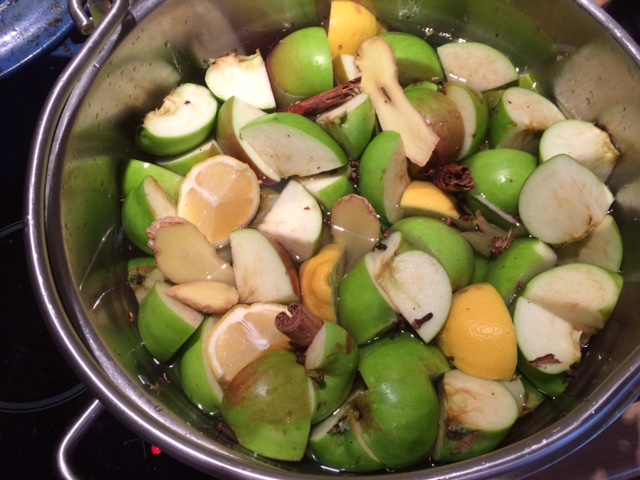
Spiced Apple Jelly

Couple of lemons
Apples (Cookers are best) However many you get!
Sugar the amount will be dictated by the amount of "jelly juice" that is caught
Spices (Stick of Cinnamon, 5 or 6 cloves, couple of slices of ginger)
Mug or two of water.


Raw materials at the start

First pop the water in a preserving pan or stockpot, then quarter the lemons and add them to the water. Chunk up the apples and add them to the lemon water add the spices and boil. Boil until everything is very soft and mushy. This is where the clever stuff happens. Put all of the pulp in a jelly bag or piece of muslin held up by any sort of frame, suspended over a bowl. (The first time I did this the muslin was suspended between the taps and handrails of my bath with a mixing bowl to catch the "jelly juice"). You can leave this for quite a while, even overnight, three hours normally does it. The juice you have caught (I call it Jelly Juice) should feel a bit slippery to touch.
Measure the volume of the liquid in pints. Add the liquid to the (now cleaned) preserving pan and add sugar to the juice with a ratio of 1 pint to 1lb (old fashioned, I know). Help the sugar to dissolve by stirring over a moderate heat and then boil until setting point is reached (105 degrees c. but you get a feel for it pretty quickly)


Boiling up to setting point

 Pot the jelly carefully, avoiding the scum* and pop the lids on. Label and enjoy.
* I keep the scum in a jar to stir into gravy as no-one will ever know. 

Potting up the jelly