To everyone ho reads this blog may I first wish a very happy New Year, may it bring us all what we want and need without giving us what we really deserve.
As you can probably tell from the title, having written last year about preserving, this year i intend to blog about Bread.
Bread, in all its forms, carries massive significance socially, religiously and politically. It is the staff of life a simple mix of flour, water yeast and salt which can lift our spirits an satiate out hunger. I has also been abused and downgraded in the interests of profit. The last few years have seen a return to a demand for higher quality bread and this is, without doubt positive.
It is perfectly possible to make great bread at home with the minimum of kit and this year I be posting my regular attempts to try new recipes using new flours and techniques. As I type I have very simple white dough proving in order to make a couple of loaves to see us through to the weekend.
It is worth remembering that when we eat together we "break bread" and in almost every culture there is a bread with massive significance.
During the year I am also looking to do research into the the global significance of bread and the components of bread too. Here's to a great 2020!
Wednesday, 1 January 2020

Monday, 30 December 2019
At year's end - A Year in Preserving
Nearly a year ago I decided to write about preserving food. Ensuring that I made as much of seasonality as I could. I have blogged about many of my experiments and regular preserves but there are a few more which, through time or technological constraints, I have been unable to report on. Green tomato ketchup, Chipotle Ketchup, Preserved Lemons and Cranberry sauce (which is really a jam) were a few of those who did not receive a blog to themselves.
The question which I must ask myself now is:" Has my view on seasonality or preservation of gluts changed at all?" I think that the answer is a very non-committal "sort of". The reason for this is actually in the fact that most people see the preservation of good things not as a way of extending natural seasons but as a way to add value. I buy salmon at £17 / kilo and turn it into Smoked salmon of such quality that it would probably retail at £40 / kilo.
There are many positives that come from this sense of luxury is that i have nbeen able to give away much of mt stash of preserved goods as presents. My Brother and his partner recieved a hamper of good things including 400gms of smoked salmon!
I am already preparing next year's theme but you will have to wait couple of days for that. I leave 2019 with a photo of just some of the bounty of the year.
The question which I must ask myself now is:" Has my view on seasonality or preservation of gluts changed at all?" I think that the answer is a very non-committal "sort of". The reason for this is actually in the fact that most people see the preservation of good things not as a way of extending natural seasons but as a way to add value. I buy salmon at £17 / kilo and turn it into Smoked salmon of such quality that it would probably retail at £40 / kilo.
There are many positives that come from this sense of luxury is that i have nbeen able to give away much of mt stash of preserved goods as presents. My Brother and his partner recieved a hamper of good things including 400gms of smoked salmon!
I am already preparing next year's theme but you will have to wait couple of days for that. I leave 2019 with a photo of just some of the bounty of the year.
 |
| Some of this year's bounty. |
Monday, 18 November 2019
Apple Jelly - A year in preserving
Marmalade was the first preserve I ever made. Spiced Apple Jelly was the second. the initial recipe came from the wonderful Women's Institute book edited by Midge Thomas. Even in a bad year there are nearly always apples to spare, especially cooking apples. I make it a matter of principle that i don't buy apples for this jelly so there is always a credit to the owner of the tree on the labels.
There is a lot of snobbery about the making of fruit jellies. I essence they can be made with any fruit that has a high pectin content as this is the setting agent. The clarity of the jelly is a matter of prie for some people. the simple truth is: the longer and less disturbed the time spent in the jelly bag the clearer the jelly. However, you may also loose flavour if you just leave it alone. It all comes down to the purpose of your jelly. For what it is worth, most of my jelly goes into gravy and sauces so a transparent jelly is not that important!
The good news about this recipe is that there are only two measurements that need to be made and you can make it with any amount of fruit.
A Jelly Bag is not a complex piece of kit. The first time i made this jelly I used a piece of muslin attached to the taps and handles on my bath with a bowl beneath. I now have a frame for muslin which is easier but much less dramatic.
An amount of apples. (I find cooking apples are best)
A lemon (optional)
Water
Spices (cinnamon, cloves, all spice, star anise, whatever you fancy)
Sugar
Cut up the apples into chunks (cores and all) and place in a preserving pan or large saucepan. Slice up the lemon if using and add it with the spices. Add enough water to, not quite, cover the apples and bring to the boil. Simmer for 20 to 30 minutes until you have a thick pulp.
Place your jelly bag over a bowl and fill it with the apple pulp. Allow the liquid to drain through until it stops. If you want a really clear jelly do not mess with the pulp during this time. If its all about flavour and volume give it a regular tickle with a wooden spoon to maximise extraction.
Now is the time for measurement. Measure the amount of liquid in Pints. Add this liquid back to your cleaned pan and add the same amount of sugar in pounds (lbds) as you have pints of liquid. heat the liquid to dissolve the sugar and then bring it to the boil. Boil until the setting point is reached. Jar and label.
The photos on this post come from the three batches I have made this year. It has any number of uses from enriching a gravy to accompanying cheese and biscuits.
There is a lot of snobbery about the making of fruit jellies. I essence they can be made with any fruit that has a high pectin content as this is the setting agent. The clarity of the jelly is a matter of prie for some people. the simple truth is: the longer and less disturbed the time spent in the jelly bag the clearer the jelly. However, you may also loose flavour if you just leave it alone. It all comes down to the purpose of your jelly. For what it is worth, most of my jelly goes into gravy and sauces so a transparent jelly is not that important!
The good news about this recipe is that there are only two measurements that need to be made and you can make it with any amount of fruit.
A Jelly Bag is not a complex piece of kit. The first time i made this jelly I used a piece of muslin attached to the taps and handles on my bath with a bowl beneath. I now have a frame for muslin which is easier but much less dramatic.
An amount of apples. (I find cooking apples are best)
A lemon (optional)
Water
Spices (cinnamon, cloves, all spice, star anise, whatever you fancy)
Sugar
 |
| Before the boil |
 |
| Nearly cooked |
 |
| Jelly bag and frame |
The photos on this post come from the three batches I have made this year. It has any number of uses from enriching a gravy to accompanying cheese and biscuits.
 |
| In jars and labelled |
Monday, 4 November 2019
Hawthorn Ketchup - A year in preserving
There are some very good reasons why Hawthorn Ketchup is not available on the high street. Firstly, in order to make two or three jars of ketchup one must pick, top and tail 1kg of Hawthorn berries; they each weigh about 1gm and its not called hawthorn for nothing!
Secondly, it really is a bit of a faff. there is a lot of of work in producing some of this interesting condiment.
The area around Corner Cottage is full of hedgerows which are also full of hawthorne. In the Spring they are alive with white blossom and covered in insects and in the Autumn the palette turns to glorious reds and oranges, a feast for the birds filling up to get through the Winter. There are many different varieties of Hawthorn and as far as i know they an all be used in this recipe. certainly many different varieties go into my ketchup.
Incidentally, the leaves and flowers of the hawthone are also edible and have hundreds of names depending on where you are in the county.
This recipe produces a reddish brown, thick ketchup. This year I made two batches: one of the standard ketchup and one with dark sugar and chilli which I dubbed "Dark and Dangerous" (in truth it is dark but not very dangerous at all).
1kg Hawthorn berries
Water
500ml White wine vinegar (Cider vinegar would do)
350gms Sugar
Seasoning
Top and tail all the berries and pop into a large pan, a preserving pan is ideal.
Add enough water to cover and boil until the burst and then become soft. Drain through a sieve and then press the berries through the sieve to produce a thick paste. This will take some time and not a small amount of physical work.
Return the paste to the pan and add the sugar and vinegar. Boil until it is thick brown and lovely. Your bacon sandwich will never be the same again!
For the Dark and Dangerous I substituted brown sugar for the white and malt vinegar for the white wine vinegar. I also added a couple of large red chillies to the initial boil.
I must apologise for not posting recently. The combination of a new school year and an enormous amount of preserving has meant that time has been pinched. I will try to catch up in the next few weeks
.
Secondly, it really is a bit of a faff. there is a lot of of work in producing some of this interesting condiment.
 |
| The harvest of the hedgerow. |
Incidentally, the leaves and flowers of the hawthone are also edible and have hundreds of names depending on where you are in the county.
This recipe produces a reddish brown, thick ketchup. This year I made two batches: one of the standard ketchup and one with dark sugar and chilli which I dubbed "Dark and Dangerous" (in truth it is dark but not very dangerous at all).
1kg Hawthorn berries
Water
500ml White wine vinegar (Cider vinegar would do)
350gms Sugar
Seasoning
Top and tail all the berries and pop into a large pan, a preserving pan is ideal.
Add enough water to cover and boil until the burst and then become soft. Drain through a sieve and then press the berries through the sieve to produce a thick paste. This will take some time and not a small amount of physical work.
 |
| Hard work! |
 |
| Adding the sugar and vinegar |
For the Dark and Dangerous I substituted brown sugar for the white and malt vinegar for the white wine vinegar. I also added a couple of large red chillies to the initial boil.
I must apologise for not posting recently. The combination of a new school year and an enormous amount of preserving has meant that time has been pinched. I will try to catch up in the next few weeks
 |
| Ready for the bacon sandwich. |
Saturday, 7 September 2019
A Year in Preserving - Damson Jam
At this time of year there is always a bit of a sense of "Here we go!" in the preserving world. There is a profusion of fruit and vegetables ripe for being preserved and hidden away for times of less bounty. There is also a sense of fear that I won't get it all done and this is not helped by the fact that, largely, I am not in control of the supply of ingredients for preserving. In some years, all the berries and fruits line up in neat chronological order and it a very simple task to organise and take on one recipe every weekend. Then there are the years like this one, where everything seems to come at once! In the past ten days I have gathered or been given enough fruit for 4 different preserves. This puts a degree of pressure on the kitchen, especially when one is trying to make the most of the last few days of the warm sunshine.
I propose to write 4 separate blog ;posts covering these preserves so they may be a little out of time. I shall start with Damson Jam.
There are two problems with Damsons: Firstly, they are different, depending on where you are in the country. Damsons, plums, bullaces and gauges tend to change their name geographically. They are all related, merely having different sizes, colours and sweetness levels. The Damsons I used looked like small (bit not tiny) blue/purple plums.
The second problem with Damsons is the fact that their stones are extremely difficult to remove. I did this by making my initial boil with the fruit whole and sieving and picking out the stones when they had split from the flesh with the heat.
My late father loved Damson Jam for the slightly strange reason that the skins of the fruit tend to form into tiny, chewy lumps rather like penny sweets.
I do not own a damson tree but, for the last few years a huge bag has been supplied by a very dear friend which contains enough for a batch of Jam and 2 or 3 ltr of Damson Gin (Post to come soon). The sharing of the plenty at this time of year is a very basic and lovely human instinct. Communities are always stronger if they share and look after each other. I will, of course make sure that the donor has a pot of Jam or two soon.
(As I am typing this I am looking at the bag of Bramley apples dropped off by another friend, earlier this week). The recipe below is quite simple (putting aside the stone removal) and it is the formula I use when starting to develop a recipe. In essence, if the fruit is quite tart, equal amounts of sugar and fruit are used.
Damson Jam
2 kg Damsons
2 kg Sugar
250 ml water
Wash the fruit and pop, whole, into a preserving pan (or a large saucepan) with the water. Bring to the boil and then simmer until the fruit has all broken down. Judicious use of a potato masher or ladle can help with this. When all is pulpy and soft, force it all through a sieve.
Pick out the stones from the remnants in the sieve and put the remaining, stoneless pulp back into the mix.
Add the sugar bring to the boil. Boil the mix until the setting point is achieved (There are loads of ways of doing this, but after a few jams, you start to gain a feel for it).
Allow the Jam to cool a little and then pot in sterilised jars. Pop the lids on, allow to cool and then store. Make sure you give plenty away to keep the virtuous circle moving.
Note. I do not put any of my jams into competitions, so I am not too worries by a few bubbles of scum at the top of some of my jams. In fact the last half jar or so, which is nearly all bubbles gets popped in a jar too. I use this jar first on toast or in a Victoria sponge. To date I have had no complaints.
I propose to write 4 separate blog ;posts covering these preserves so they may be a little out of time. I shall start with Damson Jam.
 |
| The start of something lovely. |
 |
| Fruit in the preserving pan |
My late father loved Damson Jam for the slightly strange reason that the skins of the fruit tend to form into tiny, chewy lumps rather like penny sweets.
I do not own a damson tree but, for the last few years a huge bag has been supplied by a very dear friend which contains enough for a batch of Jam and 2 or 3 ltr of Damson Gin (Post to come soon). The sharing of the plenty at this time of year is a very basic and lovely human instinct. Communities are always stronger if they share and look after each other. I will, of course make sure that the donor has a pot of Jam or two soon.
 |
| The pulp with stones removed |
Damson Jam
2 kg Damsons
2 kg Sugar
250 ml water
Wash the fruit and pop, whole, into a preserving pan (or a large saucepan) with the water. Bring to the boil and then simmer until the fruit has all broken down. Judicious use of a potato masher or ladle can help with this. When all is pulpy and soft, force it all through a sieve.
 |
| Adding the sugar |
Add the sugar bring to the boil. Boil the mix until the setting point is achieved (There are loads of ways of doing this, but after a few jams, you start to gain a feel for it).
Allow the Jam to cool a little and then pot in sterilised jars. Pop the lids on, allow to cool and then store. Make sure you give plenty away to keep the virtuous circle moving.
Note. I do not put any of my jams into competitions, so I am not too worries by a few bubbles of scum at the top of some of my jams. In fact the last half jar or so, which is nearly all bubbles gets popped in a jar too. I use this jar first on toast or in a Victoria sponge. To date I have had no complaints.
 |
| The finished article. With credit given to the fruit donor! |
Wednesday, 21 August 2019
A Year in Preserving - Pickled Shallots
The ploughman's lunch has almost become a cliche and its history will be argued about every time people sit down to a hunk of bread, a slab of cheese and a pickled onion. There is little doubt that this is the sort of lunch that a farm labourer would have taken with him into the fields to satisfy his hunger as his horses rested. However, during the 1970's it became standard fare in pubs across the country. It requires very little skill or time to prepare, thus not requiring a chef. It was made up of relatively cheap ingredients (at least compared to cold meats). It was also cold so did not require a full kitchen in which to prepare it.
I love the simple combination of bread, cheese and something acidic and strong flavoured. The powerful sharp kick of a well made pickled onion cuts through the fattiness of the cheese and seasons the whole meal. The only thing missing is a pint of foaming English ale!
We have pickled food in brine or vinegar for many centuries. As a method of preserving it is very effective. The acidity or salinity prohibits bacterial growth and as they are liquids, oxygen is excluded minimising spoilage.
My paternal grandmother produced wonderful pickled onions. Strictly speaking she pickled shallots, but she wasn't a woman one corrected. It is a shame that she passed away long before I was interested in food and so I was never able to steal her recipe but over the past few years I have developed a method of pickling onions/shallots which has never failed me.
At this time of year I purchase a couple of kilos of shallots and start pickling with one eye on the Festive period of midwinter.
Sarsons have been making vinegar since the 18th century and I always have one of their large jars of pickling vinegar in stock. These large bottles are also perfect for making your pickled onions in as they have a nice wide neck and the labels are placed on the jars with water soluble glue (I wish all producers would do this as it would make re-using much easier and cut down on the amount energy involved in recycling glass.)
On the subject of pickling vinegar, you an add any robust spices to the manufacturers product and despite what people say, left over vinegar can be filtered (I use muslin) and used again, though you will need to add some more fresh vinegar. I kid myself that I'm building up some kind of Solera system over years with this, much like the method used with some Sherries, but I suspect it is more about my imagination than any culinary truth.
Pickled shallots (will also work for onions)
Shallots (I used about 2.5 kg)
Pickling vinegar
Salt
Spics (Dried Chillies, Black peppercorns, Bay leaves, or whatever you fancy)
Place the shallots in a large colander and pour over boiling water. Leave them for 3 or 4 minutes and then peel them.
Place them in a bowl adding a good handful of salt for every layer of shallots.
Leave this bowl in the fridge for 8 to 24 hours. (I tend to go for about 16 hours)
Wash the shallots and dry them on a tea towel.
Pop them in jars with your spices and pour on the vinegar. Make sure that your onions are covered and that your spices are forced down if they float or trapped if they sink. Be careful with chillies, if you add too many you may render the onions inedible, I know this from bitter, or rather burning experience.
They will be perfectly good after about 5 weeks but will continue to improve for many months. I recommend you taste regularly to make sure!
Note - The salting process is vital. The reason why a lot of commercial pickled onions are soft and lack crunch is because they have been brined and not salted. This means that they maintain weight but loose firmness. A pickled onion without firmness is not very appealing.
I began this piece focusing on the Ploughman's lunch. Generally I tend to serve pickled onions and shallots with a cheeseboard or a supper board made up of dried meats and cheese, or I simply place them alongside the feast of leftovers that is, Boxing Day Lunch.
I love the simple combination of bread, cheese and something acidic and strong flavoured. The powerful sharp kick of a well made pickled onion cuts through the fattiness of the cheese and seasons the whole meal. The only thing missing is a pint of foaming English ale!
We have pickled food in brine or vinegar for many centuries. As a method of preserving it is very effective. The acidity or salinity prohibits bacterial growth and as they are liquids, oxygen is excluded minimising spoilage.
My paternal grandmother produced wonderful pickled onions. Strictly speaking she pickled shallots, but she wasn't a woman one corrected. It is a shame that she passed away long before I was interested in food and so I was never able to steal her recipe but over the past few years I have developed a method of pickling onions/shallots which has never failed me.
At this time of year I purchase a couple of kilos of shallots and start pickling with one eye on the Festive period of midwinter.
Sarsons have been making vinegar since the 18th century and I always have one of their large jars of pickling vinegar in stock. These large bottles are also perfect for making your pickled onions in as they have a nice wide neck and the labels are placed on the jars with water soluble glue (I wish all producers would do this as it would make re-using much easier and cut down on the amount energy involved in recycling glass.)
On the subject of pickling vinegar, you an add any robust spices to the manufacturers product and despite what people say, left over vinegar can be filtered (I use muslin) and used again, though you will need to add some more fresh vinegar. I kid myself that I'm building up some kind of Solera system over years with this, much like the method used with some Sherries, but I suspect it is more about my imagination than any culinary truth.
Pickled shallots (will also work for onions)
Shallots (I used about 2.5 kg)
Pickling vinegar
Salt
Spics (Dried Chillies, Black peppercorns, Bay leaves, or whatever you fancy)
Place the shallots in a large colander and pour over boiling water. Leave them for 3 or 4 minutes and then peel them.
 |
| Blanched and ready to peel |
Leave this bowl in the fridge for 8 to 24 hours. (I tend to go for about 16 hours)
 |
| Ready for pickling |
Wash the shallots and dry them on a tea towel.
Pop them in jars with your spices and pour on the vinegar. Make sure that your onions are covered and that your spices are forced down if they float or trapped if they sink. Be careful with chillies, if you add too many you may render the onions inedible, I know this from bitter, or rather burning experience.
 |
| Ready for storage |
They will be perfectly good after about 5 weeks but will continue to improve for many months. I recommend you taste regularly to make sure!
Note - The salting process is vital. The reason why a lot of commercial pickled onions are soft and lack crunch is because they have been brined and not salted. This means that they maintain weight but loose firmness. A pickled onion without firmness is not very appealing.
I began this piece focusing on the Ploughman's lunch. Generally I tend to serve pickled onions and shallots with a cheeseboard or a supper board made up of dried meats and cheese, or I simply place them alongside the feast of leftovers that is, Boxing Day Lunch.
Wednesday, 31 July 2019
A Year in Preserving - Rumtopf
When looking into the historical reasons for preserving foods they tend to fall into two categories: Foods to get us through times when we may not have enough nutrition to cope and also, foods which we want to keep for a special occasion or feast.
In Europe, lots of foods are preserved and put away for Christmas. It seems strange typing about Christmas at the end of July but for our forefathers and mothers this would have been the start of the planning for the feast of the Christ Child. At a later date I will discuss the culinary masterpieces that are Mince Pies and Christmas Pudding but for now, I will tell you about a treat which has fallen out of favour of late, The Rumtopf.
As with much in the food world there is much controversy that surrounds this boozy preservation of fruit, not least its origins. The Germans claim it, as do the Austrians, the Danish and the Northern Italians. I'm sure that the truth about who first preserved fruit in Rum in an earthenware pot will never be known, and I'm pretty sure it matters about as much as the pronunciation of Scones. Suffice is to say that this practice happened somewhere in central Europe first.
The idea is quite simple. One takes an earthenware pot with a lid and pops in it soft fruit as the summer and autumn season progresses. One covers the fruit with rum (and a little sugar) every time a new fruit is added. This way the fruit turns into boozy compote for pain perdu or waffles and the remaining liquid is a perfect late night toast to the birth of Christ or to see in the New Year.
My mother had owned a decorated Rumtopf pot for many years without ever using it so being the good son I stole it last New Year and, on the 1st of July I began preparations for Christmas.
The first fruit to go in was Strawberries (01.07.19)
Then some gifted Red Currents (06.07.19)
Followed by Apricots from the veg box (22.07.19)
After that some Plums from the veg box (31.07.19)
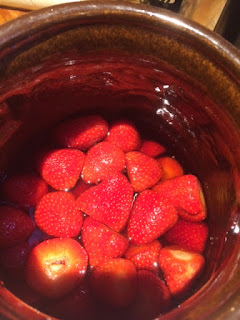 I await now some Scottish Strawberries to be followed by gathered Blackberries (the ultimate free fruit) and then I will probably be at the top of the pot.
Many of the recipes I have read suggest that the rum should be of a Central European type and definitely over proof. I have just used Lambs Navy as the cost of getting hold of very expensive rums would be a little too rich!

In Europe, lots of foods are preserved and put away for Christmas. It seems strange typing about Christmas at the end of July but for our forefathers and mothers this would have been the start of the planning for the feast of the Christ Child. At a later date I will discuss the culinary masterpieces that are Mince Pies and Christmas Pudding but for now, I will tell you about a treat which has fallen out of favour of late, The Rumtopf.
As with much in the food world there is much controversy that surrounds this boozy preservation of fruit, not least its origins. The Germans claim it, as do the Austrians, the Danish and the Northern Italians. I'm sure that the truth about who first preserved fruit in Rum in an earthenware pot will never be known, and I'm pretty sure it matters about as much as the pronunciation of Scones. Suffice is to say that this practice happened somewhere in central Europe first.
The idea is quite simple. One takes an earthenware pot with a lid and pops in it soft fruit as the summer and autumn season progresses. One covers the fruit with rum (and a little sugar) every time a new fruit is added. This way the fruit turns into boozy compote for pain perdu or waffles and the remaining liquid is a perfect late night toast to the birth of Christ or to see in the New Year.
My mother had owned a decorated Rumtopf pot for many years without ever using it so being the good son I stole it last New Year and, on the 1st of July I began preparations for Christmas.
The first fruit to go in was Strawberries (01.07.19)
Then some gifted Red Currents (06.07.19)
Followed by Apricots from the veg box (22.07.19)
After that some Plums from the veg box (31.07.19)

Many of the recipes I have read suggest that the rum should be of a Central European type and definitely over proof. I have just used Lambs Navy as the cost of getting hold of very expensive rums would be a little too rich!

Subscribe to:
Posts (Atom)
